Saturday, July 21, 2012

The Deserted Cabin


Here is an example of a volume of poetry published in 1915, just before the New Negro Renaissance grew into a full-fledged movement. The Deserted Cabin, And Other Poems was printed in Atlanta, Georgia by a major publisher named Arther Bunyan Caldwell. It’s interesting to see what styles of black poetry are deemed acceptable by mainstream whites. You can tell that the author, Sterling M. Means, makes a point not to alienate his white audience despite touching on loaded issues like the Civil War, slavery, and economic struggles in the New South.


The introduction is non-stop gushing for the “days of yore,” a nostalgic and probably inaccurate portrait of Antebellum plantation culture. Sterling Means defines the Master-Slave relationship around the concept of loyalty, citing the example of slaves who safeguarded the women and children on plantations while the white fathers and sons left to fight for the Confederacy. Here’s a bit of it:


We stayed at home and worked the farm
Your maid and wife we did not harm
We cared for them and wept for you
And to our trust were ever true


The longing for the Antebellum years seems absurd at first, but when you consider the abysmal economic situation in Georgia at the start of the century, as the South aggressively sought to industrialize while always staying two steps behind their Northern counterparts, it’s easy to see how someone could long for another time, ANY other time. The boll weevil and other factors made agriculture in general and cotton harvests in particular some of the worst ever recorded in the region.


Rather than attack Southern whites for slavery, Means focuses on how the Civil War destroyed the systems of trade and sustenance in the South, as the region became a colony for victorious Northern businessmen. Raw materials and workers were pumped out of the South while little came back in return. Means is critical of slavery, but he identifies with a South still reeling and trying to find its footing after defeat in 1865.


The one poem which was also published in the white city paper Rome Herald-Tribune is entitled Ode to the Statue of the Women of the Confederacy. You can imagine why this poem by a black poet would be seen as palatable to white audiences - It does not condone the cause of the Confederacy, but it sympathizes with those who suffered:


When the shades of want and carnage
Swung her sable curtains low,
And the music heard in Dixie,
Was the mournful bugle’s blow.
It was then the Southern mother
Smothered back the welling sigh,
And upon her country’s altar.
Gave son and husband both to die.


Means goes on to make a direct call for women’s suffrage. Moving from the Civil War to World War I (remember, this book was published in 1915), Means argues that women’s votes would lesson the national tendency and lust for war:


If the law would give them votes,
They would soon disband the armies;
…
Never would devoted mothers
Train their sons for savage war.


Unlike many brash New Negro works from the 1920s, which labeled the South as merely a stain and a hell to be avoided at all cost, Means describes the painful experience of returning home to one’s plantation to find abandoned, rotting cabins and no traces of your ancestors, the feeling of uprootedness. Millions of black lived in the South – until the 20th century the great majority of the black population lived in the Southern states. While atrocities were common and food was scarce, it was a home that was hard to cut ties with.


In the poem Ise Gwine Back to Yazoo County, he describes “de panic”- a time when people are starving, he is foreclosing on his home and all his possessions are being taken by creditors. Although he knows the plantations are abandoned, he decides to travel back to his Antebellum home in Mississippi. Migration was not always a one-way street going North:


House-rent man wuz hyeah yistidday,
An fu’n’ture agent, too;
But I tol’ ‘em boaf perlitely,
Dar wuz nuffin’ hyeah ter do;
Ef dey wanted any money,
Take de house an’ f’n’ture ‘long;
Fur de times is mighty squally,
White folks’ bizness done gone wrong.
…
Ise gwine back ter Yazoo Country;
It is whur de times iz fair;
Dar is whur mah muddeer’s buried,
An’ her spirit slumbers dar.
Sense Ise been in Jeff’son County,
I has strayed erway f’um God;
I done lef’ mah mudder’s trainin’,
Now Ise passin’ ‘neaf de rod.


The publisher, A.B. Caldwell, played a prominent role in race relations in Atlanta. In 1917 he began publication of his biographical series History of the American Negro and His Institutions. The books told the accomplishments of hundreds of black leaders, each bio accompanied by a dignified photo. They continue to serve as vital tools for patching together family histories. New volumes were published for different states and regions in the South. In 1922, Caldwell published an autobiography of the black president of the West Virginia Industrial School, Theological Seminary and College, Jared Maurice Arter, entitled Echoes From a Pioneer Life. The Virginia Theological Seminary was a very important institution in its day, and was the cornerstone of a vibrant black community in Lynchburg, Va.


I’m not sure if A.B. Caldwell was white or black. I do know that he was the first pastor of the Log Cabin Community Church, a congregation which opened its doors to different denominations and even different races. His wife ran the Ladies' Aide Society. It wasn’t not unusual for a Southern publishing company to be run by a religious man, in this case a Baptist preacher. Christian groups controlled and spearheaded much of the literary publishing in the late 19th century and early 20th century in the South.


Tuesday, July 10, 2012

Mistress and Slave


Here is a stunning poem by an otherwise unknown female poet published in the Christian Recorder in the mid-19th century. The Christian Recorder was the widest circulating black newspaper during the 1800s. It was published by the African Methodist Episcopal Church. The printing operations were originally established just for producing hymnals and parish handouts, but expanded in the 1860s and 70s. Fighting against slavery and supporting the Union, the paper gained popularity during the Civil War. Until the end of the war, it was banned in the Southern States, but after the North's victory, sales expanded into the new Southern market. In the 1880s and 90s, a Western Christian Recorder was created for the frontier as well as a Southern Reporter for the Black Belt states.

This poem details the creepy narrative of white masters taking advantage of both their slaves and their wives, with women shifting unsteadily between the roles of maidens and mistresses. The speaker is a slave brushing the hair of her young white Lady:
"Mistress and Slave"
Ellen Malvin (12 Dec. 1863)

He wooed her with a lofty grace
And a haughty head unbent;
He touched her with his courtly smile,
And her simple heart outwent;
Ere ever she had learned
What its quicker beating meant,
She mutely dreams with folded hands,
While I, beside her chair,
Before his coming brush and wind
The sunny rings of hair
Slowly she lifts her eyelids
To the mirror, seeing ne'er
How her blue-eyed childish beauty
Pales before my image there.
Dreaming- with her jeweled fingers
Toying in their white unrest,
With the rosebuds that he brought her
Blood-red blossomed on her breast.
To her girlish heart he seemeth
Of all men the noblest, best;
And the world doth give him honor,
Grave men listen when he speaks,
And his tones send rosy pleasure
Flushing to her lily cheeks.
But a troop of dark-browned minions,
Trembling at his bidding wait,
And his shame is on the faces
Of the children at his gate.
But the fear, the shame, the sorrow,
Never haunt the dreamer here,
Dreaming o'er again, the music
Murmured in her maiden ear;
I can say the very words
That he whispered low and clear;
For when he uprose to leave her,
With the last kiss dropt for going,
There I met him face to face.
All his beauty on him glowing,
And my heart stood still within me,
In a sense of dread foreknowing,
For I saw the instant passion
Through his hot blood mounting higher,
Till his burning eyes devoured me
In their fierce exultant fire.
Darkly rose my doom before me,
Slave and victim as the rest;
She, a blossom to be gathered
Just to wither on his breast.
I, a queen to be dethroned
And ground beneath his heel in jest.
I a queen by right of beauty
I a slave by wrong of birth.
Lips and eyes and braided tresses
Valued at their market worth,
For one vile drop within my veins
That links me to the subject race;
To lose my crown of womanhood
For some foul semblance in its place,
Shall I curse her for her glad heart
Throbbing 'neath the snowy lace?
Shall I hate her for the whiteness
Of her cheek, so girlish fair,
For the simple Northern beauty
Falling down her golden hair?
Nay, let her dream on while she may,
For her I have no curse to spare,
Smiling 'mid her flowers and laces,
Petted child, and wife to be,
From this trance of happy worship
She shall bitterest waking see.
Not to us alone the sorrow,
We who suffer, we who toil,
For the serpent's sin so winding
Round their lives his slimy coil.
On our tyrants, our oppressors,
Fall the lightning curses fast,
On a nation old in sinning,
Ere the flush of youth is past,
Who the old world's crime of crimes,
In her first fresh furrow cast.
Not in vain our cries are cleaving
Upward to the throne of God.
Long her sons shall writhe in anguish
Under the avenging rod,
Ere the wo[e]ful sheaves are garnered
And the bloody vintage trod.
-Taken from African American Women's Poetry in the "Christian Recorder", 1855-1865: A Bio-Bibliography with Sample Poems - Eric Gardner


Friday, July 6, 2012

Irony and Brutal Honesty - H.L. Mencken and the Renaissance


Following up on last week’s post on Benjamin Brawley, an intellectual on the fringe of the New Negro movement, I move to another figure who has been cast off in historical analyses of the Harlem Renaissance: H.L. Mencken.


Mencken was a white satirist with a bitter, no-holds-barred style who was all the rage in the late 1910s and 1920s. Editor of the popular journal American Mercury, he wrote reviews and essays which defined or rocked the current literary trends. Although certainly not a nurturing personality, his honest criticism and connections to key avenues for publishing made him a hugely important ally for young black writers.


His disregard for political correctness, his use of racial slurs (for all races), and his refusal to tackle even the most serious issue without a heavy touch of irony and ridicule makes his work unappetizing for today’s critics. In the book The Sage in Harlem, Charles Scruggs investigates Mencken’s role in the Harlem Renaissance in an effort to reshape his legacy. This is one of those non-fiction books that reads like a great novel – the author is personally invested in the subject and is unafraid of putting personal opinions and flourishes into the text. I recommend it.


Mencken is distinctive because he approached blacks on equal footing – he judged their work as he would a white writer. If it was crap, he told the author so; if it had merit, he published it. While some white publishers were beginning to buy into the “primitivism/exoticism” of black literature, or publishing black works out of charity, Mencken did not degrade black authors in this way. He published Countee Cullen, George Schuyler, James Weldon Johnson and others. He stressed realism and spat on Puritanism, holding up accuracy and honesty as ideals rather than moralistic concerns. He criticized black writers for being too sentimental – basically for crying too much – and called on them to create great works that were a little rough around the edges.


In a book review, Mencken outlined his challenge for black writers:


“The thing we need is a realistic picture of this inner life of the negro by one who sees the race from within – a self-portrait as vivid and accurate as Dostoyevsky’s portrait of the Russian or Thackeray’s of the Englishman. The action should be kept within the normal range of negro experience… The negro author who makes such a book will dignify American literature and accomplish more for his race than a thousand propagandists and theorists. He will force the understanding that now seems hopeless. He will blow up nine-tenths of the current poppycock.”


Realism, detail, brutal honesty – Mencken stressed it again and again. He looked to the examples of the Russians and the realism of types like Emile Zola when crafting a critical ideal. This approach influenced Langston Hughes, Zora Neale Hurston, Claude McKay, everyone. I imagine Mencken and Benjamin Brawley would have utterly despised each other. Dirty realism and polished Victorianism don’t mix.


.Mencken attracted the most notoriety in his career for his brutal condemnation of white Southern culture in the essay “The Sahara of the Bozart” from his book Prejudices. Here are a few bits from it which demonstrate just how harsh and snarky he could really be:


“Virginia is the best of the south to-day, and Georgia is perhaps the worst. The one is simply senile; the other is crass, gross, vulgar and obnoxious. Between lies a vast plain of mediocrity, stupidity, lethargy, almost of dead silence.”


“I published a short discourse on lynching, arguing that the sport was popular in the south  because the backward culture of the region denied the populace more seemly recreations… brass bands, symphony orchestras, etc”


“The southerner, at his worst, is never quite the surly cad that the Yankee is. His sensitiveness may betray him into occasional bad manners, but in the main he is a pleasant fellow - hospitable, polite, good-humored, even jovial. . . . But a bit absurd. ... A bit pathetic.”


Its important to remember this tone when thinking of Mencken’s role in aiding the budding generation of black writers – he wasn’t patting them on the back by any means, but was treating them as writers rather than charity cases or brutish animals.


Did blacks write satires like The Sahara of the Bozart ? Charles Scruggs argues that they did, but that we must expand our definition of satire to see them as such. Satire usually resides in the realm of fiction. Blacks were not writing picaresque novels or farces, they were describing daily struggles – and yet the racism they had to deal with was so absurd that irony was the most apt register for discussion. Can you sustain a serious essay arguing simply “Lynching is wrong?” Does it help if you tack on a mountain of facts to prove your irrefutable original point? No. Better to laugh and expose the desperation and hypocrisy of the Klu Klux Klan than act as if they have any legitimacy in the first place.


It would be interesting to look further into black satire during the period. I doubt I could find much in poetry – satire seems to need a longer format to develop its conceit whereas poems have to be heartfelt and concise. George Schuyler wrote satire in his “Shafts and Darts” column in The Messenger. He also published an absurd novel called Black No More in which a scientist invents a way to turn dark skin pigment white. After everyone changes themselves white, you can still tell the black people apart because the treatment makes them more white even than white people. In result, the whites discriminate against them, and the new fad among whites becomes getting a super dark skin tan to separate themselves from the chemically changed blacks. Absurd. Aaaaabsurd.


Schuyler explained his motives:

“What I have tried to do in this novel is to laugh the color question out of school by showing up its ridiculousness and absurdity.”


There are other black figures – E. Franklin Frazier, Theophilus Lewis, Wallace Thurman – who tried their hands at satire also. All of them were at the periphery of the New Negro movement but are worth a closer look. My teacher, Professor McDowell, specializes in 18th century satire but I’m sure she would also have insights about this side of the Harlem Renaissance. It would be worth asking her and hope that she pushes me in an interesting direction.


Monday, June 25, 2012

Benjamin Brawley - Contested Notions of Uplift


While we view the Harlem Renaissance as a glorious flourishing of Black arts, some leading contemporary critics were at best wary and at worst disgusted with the new movement. In Benjamin Brawley and the Compass of Culture, Jeffrey Williams describes a much more contentious, varied artistic landscape in the 20s and 30s than we tend to picture. He begins with a discussion of “racial uplift,” the idea that through art and literature blacks could rise in society and slowly change racism to respect. While most of the leading artists of the time believed in the empowering nature of art, Langston Hughes differed from Du Bois who differed from James Weldon Johnson who differed from Brawley. Trying to push aside more than a century of white caricatures which had monopolized public representation of blacks, 20th century artists held the burden of presenting their race through the work they created. Today, Benjamin Brawley is largely forgotten, cast aside as an upper-class black leader whose Victorian sensibilities prevented him from embracing the inevitable momentum of the Harlem group. There is still lots to learn from him, however - there was more than one way to approach “uplift.”

Benjamin Brawley


Brawley grew up in the aristocratic black community of Charleston, Virginia. His father was a college-educated Baptist preacher and prominent literary figure. Like many Southern leaders, Edward Brawley went North to go to a more prestigious school before returning South. He sought to blur the Color Line by talking up his concept of “American Christians,” highlighting common religion between whites and blacks while avoiding the race question. From a young age, his son Benjamin Brawley was attracted to teaching, and his top-notch education and genteel mannerisms made him an example for other blacks. After excelling at Morehouse College, he eventually became the head of the English department at Howard University, positioned at the helm of the black cultural movement.


Brawley saw excellence in writing as proof of a cultured people. As Jeffrey Williams notes, blacks had a “mandate for achievement… black elites (like Brawley) regarded every instance of advancement, or individual achievement, as ammunition in the barrage against exclusionary racial barriers” (29). It was not “art for arts sake” by any means. Brawley looked to the North and to Western Europe for definitions of culture, hoping to match whites on their own playing field. He published tons of anthologies and biographies chronicling black heroes and scholars, desperately striving to change the national image of African Americans by piling one accomplishment on top of the other until they breached the ceiling of racism. Like Du Bois, he put his faith in the black aristocracy, hoping the few rich blacks who were able to get an education and establish a prominent role in society could stand in as figureheads for a race that still was rough around the edges. Any public presentation of black life should put the best face forward – the race needed as many positive images as possible.


For that reason, when Langston Hughes released portraits of prostitutes, gamblers and street fighters in his poetry collection Fine Clothes to the Jew, Brawley tore it apart, lamenting how such a talented artist could go so horribly wrong. In Harlem, Hughes, Claude McKay, Jean Toomer and others were creating an aesthetic of gritty naturalism – rather than sticking to “safe” figures such as teachers or sports stars, they looked for inspiration in poor urban black communities. Truth trumped uplift. Hughes criticized Brawley for clinging to the white man’s coattails rather than embracing a dawning African American aesthetic. Many Harlemites turned to a Primitivist style which sexualized the sordid, dirty, fast rhythms of the urban slums. Carl Van Vechten’s hugely popular novel Nigger Heaven split critics down the middle, with some praising the work and others calling it a spit in the black community’s face. After years of being labeled as lazy, violent or sex-crazed, conservative critics saw Hughes’ and Van Vechten’s works as a step backwards. I believe Hughes sought to highlight the resiliency and richness of urban slum dwellers rather than make fun of them, but at a time when the dominant pictures of blackness in America were lynchings and minstrels, a negative portrayal by one of your own kind hurt that much more.


Hard Luck – Langston Hughes 
When hard luck overtakes you
Nothin' for you to do.
When hard luck overtakes you
Nothin' for you to do.
Gather up yo' fine clothes
An' sell 'em to de Jew.
Jew takes yo' fine clothes,
Gives you a dollar an' a half.
Jew takes yo' fine clothes,
Gives you a dollar an' a half.
Go to de bootleg's,
Git some gin to make you laugh.
If I was a mule I'd
Git me a waggon to haul.
If I was a mule I'd
Git a waggon to haul.
I'm so low-down I
Ain't even got a stall.


It’s important to note the spectrum of opinions regarding how to uplift African Americans: While Brawley was conservative in comparison to Langston Hughes, they both saw art as the ticket to respect, while Booker T Washington’s Normal School Industrial Model merely stressed the dignity of labor. WEB Du Bois, now heralded as a genius and powerful leader, let his notions of Victorian class superiority seep into his sociology analysis The Philadelphia Negro. It chronicled racism in the crime-ridden black ghetto, but the author could not escape some degree of disgust when discussing the urban squalor. On the other hand, James Weldon Johnson, a member of the “Old Guard,” abandoned Victorian Classicism in favor of folk art through his collection God’s Trombones, an extended poem which takes the form of a Negro sermon. Ideologies varied from person to person, and many scholars contradicted their own ideologies when circumstances changed. At Howard University, Brawley the Victorian worked in the same department as Sterling Browne, a poet who embraced the rural vernacular forms of poor Southern farmers. Black leaders saw the same finish line but diverged in their paths, everyone taking a different view of uplift.


Listen Lord

A Prayer – James Weldon Johnson


O Lord, we come this morning
Knee-bowed and body-bent
Before thy throne of grace.
O Lord -- this morning --
Bow our hearts beneath our knees,
And our knees in some lonesome valley.
We come this morning --
Like empty pitchers to a full fountain,
With no merits of our own.
O Lord -- open up a window of heaven,
And lean out far over the battlements of glory,
And listen this morning.


Lord, have mercy on proud and dying sinners --
Sinners hanging over the mouth of hell,
Who seem to love their distance well.
Lord -- ride by this morning --
Mount your milk-white horse,
And ride-a this morning --
And in your ride, ride by old hell,
Ride by the dingy gates of hell,
And stop poor sinners in their headlong plunge.


And now, O Lord, this man of God,
Who breaks the bread of life this morning --
Shadow him in the hollow of thy hand,
And keep him out of the gunshot of the devil.
Take him, Lord -- this morning --
Wash him with hyssop inside and out,
Hang him up and drain him dry of sin.
Pin his ear to the wisdom-post,
And make his words sledge hammers of truth --
Beating on the iron heart of sin.
Lord God, this morning --
Put his eye to the telescope of eternity,
And let him look upon the paper walls of time.
Lord, turpentine his imagination,
Put perpetual motion in his arms,
Fill him full of the dynamite of thy power,
Anoint him all over with the oil of thy salvation,
And set his tongue on fire.


And now, O Lord --
When I've done drunk my last cup of sorrow --
When I've been called everything but a child of God --
When I'm done travelling up the rough side of the mountain --
O -- Mary's Baby –
When I start down the steep and slippery steps of death --
When this old world begins to rock beneath my feet --
Lower me to my dusty grave in peace
To wait for that great gittin' up morning -- Amen.

Saturday, June 16, 2012

(Not So?) Great Migration


I just read an interesting book on the Great Migration of blacks to the North in the 1910s and 20s, called Farewell, We’re Good and Gone. Rather than the excited optimism of the Harlem community and journals like Opportunity, the author (Carole Marks) takes a much darker, long-term view of the mass exodus from the South. She analyzes blacks in comparison to European immigrants, viewing the move Northward as similar in struggles and dynamics as the journey across the Pacific. Much like European migrants, blacks arriving in the North were completely vulnerable, with little money and no property. Therefore, they eagerly accepted the worst jobs in order to pay the rent and establish their families in the new area. Many migrants even signed work contracts before leaving the South, agreeing to pay scales they did not realize were greatly below the average in the industrial North. This bottom-tier position is part and parcel of the migrant experience, but Carole Marks argues that blacks never truly escaped that state of vulnerability.


First of all, what caused the large-scale migration? WWI took many white Northerners overseas, but more interestingly, mid-decade legislation blocked immigration TO the US from countries at war, so the flow of cheap labor from Eastern and Western Europe was cut. Many newly-arrived immigrants also returned to their home countries to fight. So Northern industries needed replacement labor.


The boll weevil infestation decimated the cotton-dependent farms across the South, creating conditions of horrible poverty. The bug first came to Texas in 1892 and slowly spread eastward for the next thirty years until 1922. Rural blacks not making ends meet by farming moved into the cities, crowding out the already established urban black population.


In 1912 Woodrow Wilson was elected, and a federal government which previously had been somewhat of a check to racist Southern state authority, now gave their support to Jim Crow policies. To give you a sense of the inequality, the per capita education expenditures in 1916 for whites was $10.32; for blacks each student received $2.89 in attention. These disparities were across the board.


Agents for Northern companies and even from the federal government came South around 1915 to recruit workers, even paying their travel fares or loaning them the money and later taking it out of their first paychecks. This got some of the excitement started. However, word of mouth within families and communities was a much more powerful force in the push northward. By 1916 or 1917, blacks did not need promises of travel loans to head North – they used their savings and sold property in order to make the journey as soon as possible.


The author stresses that is wasn’t all rural, uneducated blacks who made their way North. The transformation didn’t go straight from the cotton field to Harlem. Before going North, rural blacks would often move to a close by Southern city and try their luck there. Therefore the blacks who were already living in the cities were often the ones pushed out and feeling the need to migrate. Many of these people were already industry-trained and some were educated. Studies have shown that the literacy rate of black migrants at this time was significantly higher than rates for the many different waves of European migration at the turn of the century.


You would think blacks would have an advantage because they speak fluent English, many were trained, many were literate; they were already citizens. But racism changed the game. While many European immigrant groups were originally ostracized because they threatened white jobs or crowded cities, blacks were hated for their blackness long after uneasiness over their migrant status dissolved. And their previous training in Southern industry rarely helped better their position in the North. The mechanizing of production caused homogenization in jobs while downgrading specialization. Often, skilled blacks had no chance to use their knowledge, instead working in bottom-feeder jobs with no promotional opportunities.    

White workers often got into conflicts with blacks over strikes and union actions. Blacks were excluded from all unions in the 1920s. Also, they were desperate for work so they were often employed as strikebreakers. Many strikes were unsuccessful because of the endless supply of black labor willing to take over the positions. Furthermore, in many businesses employers strategically employed a mix of white workers, blacks and newly arrived Europeans. The theory was that the three groups would never be able to unite and act collectively against company policies. It often proved successful.

The North received all the benefits of migration while the South lost out. Southern governments and economies paid the cost to educate and train blacks, only to have them travel North and use their skills in Northern industry. The author described the exploitative relationship as a penetration of the rural periphery by the urban core, and the penetration of the raw material-based Southern economy by the efficient Northern one.


 How does all this talk about migration relate to poetry? The vibrant Harlem community was created by an influx of blacks in the late teens and early 20s, encouraged by a dirt-cheap housing market in the area and several key developers who saw opportunity in renting out entire buildings to black populations who would fill vacancies immediately. Survey Graphic’s “New Negro” 1925 issue gloriously proclaims Harlem as a race capital and one article details the traits of the real estate market which made it so attractive to blacks. Carole Marks’ book does not echo this celebratory tone. She does not see the slow establishment of blacks in Northern life. Comparing the percentage of blacks under the poverty line and the percentage in the middle class in 1920 and 1960, she sees little change, few signs of improvement.


It’s good to check my enthusiasm a little bit, since all I’ve been reading have been passionate poems about a black renaissance, with no horizons as to what the race can do..blah blah blah.


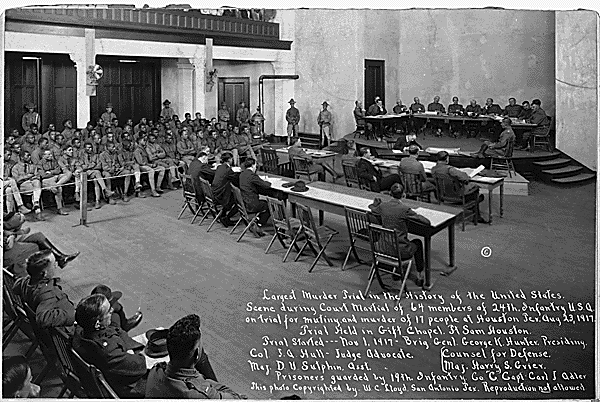
You can see where racism and censorship effected poetry publication here: After a riot between blacks and whites on a military base in Texas in which many whites died, scores of blacks were sentenced to death while not one white soldier was charged. Archibald Grimke wrote a poem denouncing the convictions, but WEB Du Bois refused to print it, because he had been “specially warned by the Dept. of Justice that some of our articles are considred disloyal,” adding “I would not dare to print this just now” (96). Who knows in what other ways poetry was censored and molded to meet government and cultural trends and fears.


Look at all the soldiers on trial on the left. This is a crazy picture.

Friday, June 1, 2012

Opportunity and Crisis Magazines

Interesting note #1: Countee Cullen studied at NYU. He won national poetry awards and took the lead in the literary movement when he was still an undergrad here. NYU seems so stuffy now, but we've got a proud history.


To start my research in the Harlem Renaissance and poetry publishing I focused on the two main black magazines from the 1920s, Opportunity and Crisis. Bobst has every volume of each, so I was able to flip through them and find the poetry. Opportunity featured a lot of poetry, and had yearly writing contests that created a lot of excitement and resulted in some great works. Crisis also included poetry, but it was not the main focus of the magazine. So far, I have only looked at Crisis issues from the 1910s, before the “Renaissance” started. At that time, Crisis was unparalleled as a black magazine (Opportunity didn’t start until 1923). In the first couple years, lynching was the main issue for Crisis, and so poetry seemed largely out of place. Some poems about lynching appeared. In general, poems were accompanied by an article about the same topic. The issues generally had one theme (Children, or Education, or Women) so poets probably submitted work to fit that theme. A lot of the poems that appeared were tied to recent events or were elegies for black leaders who had died.


WEB Du Bois was the editor of Crisis. Charles Johnson was the editor of Opportunity. Johnson organized dinners and gatherings of white and black publishers, writers and intellectuals that did wonders for the literary movement, helping people get contracts and form collaborations. Unfortunately, Opportunity did not have enough money to pay its literary contributors, so it was not a means of livelihood for the poets, only a way to broaden their audience and hopefully get a publishing deal. The Messenger was another journal that included poetry, but it had a smaller circulation and was more radical and socialist so it had a smaller impact.


Paul Lawrence Dunbar was the idol and father of the literary movement. He wrote in the late 1800s (died in 1906), and was the first black to achieve national recognition for verse. He was technically gifted but also gained fame through dialect poetry, imitating black speech patterns in a less patronizing way than white poets. James Weldon Johnson was one of the leaders of the early poetry group in the 1910s and 20s. Countee Cullen and Langston Hughes were the darlings of the early 20s, with Arna Bontemps emerging in the late 20s after winning two successive Pushkin competitions by Opportunity Journal.


There was a heated debate over art vs. propaganda: whether poets should focus on beauty and personal expression or keep their eyes on bettering the black race. Some poets wished to honestly portray black life, even if some parts reflected badly on the race. Others, following the “Racial Uplift” philosophy, felt that only positive, shining examples of the race should be represented in art.

I was surprised by how many artists had published volumes of their work in the 1920s. There seemed to be a fair amount of white publishers who recognized a demand for and value in black poetry. The story of Paul Lawrence Dunbar paying for and distributing his own poetry at the turn of the century seems completely outdated by the 20s.


Areas for Further Research

I’d like to look into Southern magazines. Both Crisis and Opportunity were based out of New York. Howard University had a literary magazine (Stylus) that I’ll check out. Since the literary movement in Harlem has been so deeply studied, and the South is often presented as the opposite of culture, as a place to flee from, I would love to find bits of literary society in Mississippi and Alabama and Georgia.


I’d also like to look at some magazines and newspapers that aren’t exclusively black, like Harper’s and the New York Times, to see which black poems they choose to publish and how frequently. I don’t want to scan every issue of the New York Times from the 1920s, however. Perhaps by looking at the publication information in the anthologies by Johnson, Kerlin and Cullen I’ll be able to find the specific issues and go poem by poem. A librarian would be able to help me find copies of the New York Times. I know some are in microfilm, but it would be much quicker and easier to look at them online.

I could also look at black newspapers (not magazines) and see how often poetry appears there. Opportunity featured a yearly ranking of the best black periodicals.